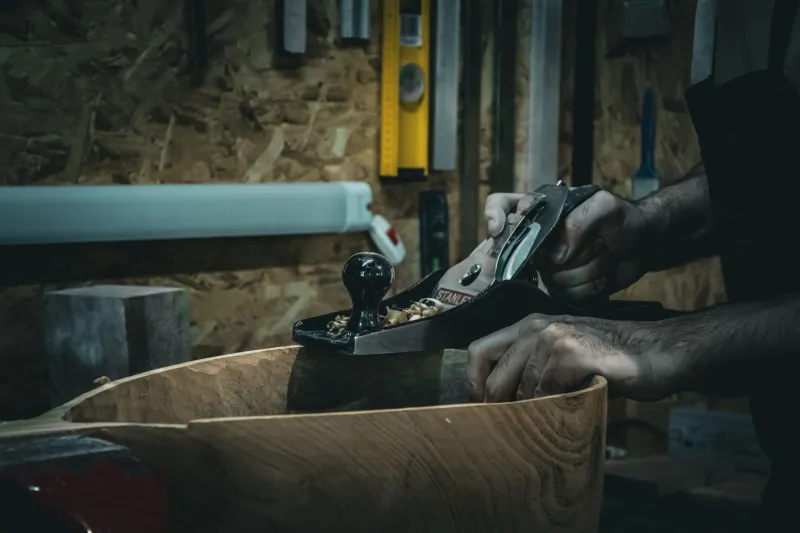
The Acorn Ledger: What Single-Tree Furniture Really Means for a UK Home

Photo: Jonathan Billinger , CC BY-SA 2.0, via Wikimedia Commons
Most furniture tells you what it is made of. Very little tells you where it came from. A table might be described as 'oak', but that oak could have grown in one country, been milled in another, dried somewhere else and assembled in a workshop with no obvious connection to the woodland. There is nothing automatically wrong with that — it is how most furniture is made — but it is not much of a story.
Single-tree furniture is different. It asks you to care about one tree, one log, one set of boards and one maker who decided what to do with them. That is the promise behind our name at One Tree Furniture, and it is also where the practical questions begin.
What 'single-tree provenance' actually means
In plain terms, single-tree provenance means the timber in a piece can be traced back to an individual tree. Not just a species. Not just a country. A tree, usually with a record of where it grew, when it was felled, why it came down, when it was milled and how it was dried.
That does not mean every board in a table came from one trunk with no waste. A single tree may yield a dining table, a bench, a shelf and a few smaller pieces. Some boards will be too knotty, too short or too cracked for the main event. Good makers design around that. The point is that the material is legible. You can follow it from woodland to workshop to room.
This is where single-tree provenance differs from ordinary 'sustainable wood' claims. A certified timber scheme is valuable because it gives assurance about forest management and chain of custody. But certification is not the same as a personal trace. A certified board can still be mixed with other certified boards from different forests, counties or countries. Single-tree sourcing is narrower and more human. It is not automatically more sustainable, but it is more accountable — and accountability is worth something.
Why British homeowners are asking harder questions
There is a growing appetite for furniture with a local story. Some of that is aesthetic: UK-grown oak, ash, elm and sycamore have character that imported timber sometimes lacks. Some of it is environmental: shorter supply chains, less transport, better use of local woodland. Some of it is simply that people are tired of buying anonymous objects.
Woodland management matters here too. Britain's woods need active management — thinning, felling and replanting — if they are to stay healthy. A market for UK-grown timber gives woodland owners a reason to do that work. Mobile sawmills have made it easier for small parcels of timber to be milled close to where they are felled, rather than being hauled across the country. That is part of why single-tree furniture has become more visible in recent years.
From standing tree to finished piece
The process is slower and messier than the showroom version suggests. A tree is felled, usually as part of a wider management plan. The log is milled, often on a mobile sawmill, into boards of useful thickness. Those boards are stacked, stickered and air dried for months or years, then usually kiln dried to bring the moisture content down to a level suitable for a UK home. For interior furniture, makers typically aim for something in the region of 8–12% moisture content, depending on the species and the room.
Then the real work starts. Grain has to be matched. Defects have to be worked around. Boards have to be jointed, planed, shaped and finished. A single tree gives you continuity of colour and grain, but it does not give you uniformity. Two boards from the same trunk can behave quite differently once they are cut and dried.
The awkward bits nobody mentions
Single-tree furniture is not a magic upgrade. It can be more expensive because the yield is lower and the maker spends more time selecting and arranging boards. It can take longer because drying cannot be rushed. It can be less predictable because every tree is different. And it is not automatically better than well-made furniture from certified mixed supply. A beautifully made piece from a good mill using certified timber may be a more sensible choice than a poorly made piece from a single tree.
The honest version of the story includes the compromises. Knots, cracks, sapwood, tension and colour variation are not faults to be hidden. They are evidence of the material. A good maker will show you the boards, explain what they are likely to do and design joints and fixings that allow for movement.
Questions to ask before you commission
If a maker claims single-tree provenance, ask for specifics. Which species? Where did it grow? Why was it felled? When was it milled? How was it dried, and to what moisture content? Can you see photographs or samples of the actual boards? What finish is being used? What happens if the top moves or cracks? What is the warranty, and what does it actually cover?
A good maker will not mind these questions. They will probably enjoy them. Vague answers are a warning sign. So is a story that leans heavily on romance but says nothing about drying, moisture or movement.
What this means for a real room
Single-tree furniture works best when you let it be itself. A dining table with boards laid in sequence, a bench with a visible knot, a shelf with a live edge — these pieces ask for a room that is not too polished. They sit well in period homes, but they can also bring warmth to a modern kitchen or hallway. The key is to specify the finish and the environment sensibly. A timber that is lovely in a dry living room may be a poor choice beside a shower or a wet sink.
In 2026, the appeal of single-tree furniture is not that it is perfect. It is that it is specific. You are not buying 'oak'. You are buying a particular oak from a particular place, worked by someone who can tell you what happened to it. That is a quieter, more honest kind of luxury — and for many UK homes, it is exactly the right one.