Second Time Around: How to Spot, Save and Style a Pre-Loved Wood Piece
Photo: Lkabs, CC0, via Wikimedia Commons
There is a particular kind of satisfaction in carrying a slightly grubby chest of drawers out of a charity shop for twenty quid, knowing that underneath the sticky varnish is sixty years of good, dense timber. It's also a gamble. Sometimes you've found a keeper; sometimes you've bought a Saturday of sanding and a piece that will never quite sit flat.
The difference between the two is usually visible in about ninety seconds — if you know where to look. This is a guide to doing that, and to what comes after.
Where the good stuff actually turns up
Most people start and end with the local charity shop, and that's fine — British Heart Foundation furniture shops and hospices with dedicated furniture units are reliably worth a weekly look. But the broader circuit matters:
- House clearance and salvage yards for the bigger, heavier pieces that charity shops can't shift.
- Local auction houses for box lots and mid-century pieces that get overlooked when the room is full of brown furniture.
- Facebook Marketplace and eBay, where poor photography regularly hides excellent joinery. Search for misspellings — plenty of people can't spell 'Ercol'.
- Car boot sales and church sales for small stuff: stools, trays, plant stands.
Timing helps. Charity shops restock through the week and Saturday morning is picked-over; a Tuesday lunchtime is better. Auction viewing days are free and give you an hour with a torch and a tape measure — always go if you can.
Solid or veneer? Check before you commit
Veneer isn't a bad word. Plenty of the best twentieth-century furniture is veneered onto plywood or blockboard, and it's stable and beautiful. But it changes what you can do with a piece, so you need to know.
Look at the end grain on an exposed edge — a drawer side, the underside of a top. Solid timber shows continuous grain running through the thickness. Veneer shows a thin face layer over a core of something else, often with a visible glue line. Look also at figure: if the pattern on a tabletop repeats exactly, like a printed fabric, that's veneer. And feel it — veneer feels marginally warmer to the touch than solid wood in a cold room, oddly enough.
One specific warning: veneer and water don't mix. Lifting, bubbling or a chalky white bloom along an edge usually means damp, and it's a job for someone who knows what they're doing.
Reading the joinery
This is the fastest way to date a piece and judge its quality in one go.
- Hand-cut dovetails on drawer corners — irregular spacing, fine pins — point to pre-war or bespoke work.
- Machine dovetails with perfectly even spacing are fine, just later and more common.
- Mortise and tenon frames, visible as a pegged or wedged joint at a leg, are a good sign.
- Screws and staples holding a frame together suggest a cheaper, later piece.
Pull out a drawer and look at how the runners are made. Wooden runners are traditional; metal runners are a sign of mid-century onward. Neither is wrong, but a drawer that scrapes along a worn wooden runner is easy to fix, while a broken metal slide may not be.
Naming the timber
You don't need to be a dendrologist, but knowing roughly what you're looking at helps you decide if the price is fair. Oak has a coarse, open grain and pale flecks called medullary rays when quarter-sawn. Mahogany is dense and reddish with a fine, close grain. Teak is golden-brown and unmistakably oily. Walnut is dark, chocolatey and soft-grained. Pine has knots and a resinous smell. Beech is pale, pinkish and often used for utility furniture and school chairs.
Smell matters too. A musty, cellar-like odour usually means stored damp; a faint beeswax and camphor smell is a good sign.
Woodworm, wobble and water
Three checks, every time:
- Woodworm. Look for small flight holes, fine sawdust-like frass beneath the piece, and damage on the underside of legs and back panels — places nobody dusts. Fresh dust means active; dry holes with no dust are usually historic and often harmless.
- Wobble. Push gently on opposite corners. A little flex is normal; a frame that racks noticeably has loose joints.
- Water. Check the feet for dark staining and softness, and look under the top for old ring marks or swelling.
Is it worth restoring?
A useful, unsentimental test: would you pay a professional to do the work, and would the finished piece be worth that? Restoration costs are mostly labour, so a small, simple piece in poor condition rarely adds up. A well-made table or chest in good structural order, needing only a clean and a coat of finish, almost always does.
Sentimental value and quality of timber are legitimate reasons to ignore the maths entirely. Just be honest about which one you're doing.
Bringing it back, gently
Work in this order: clean, repair, then finish.
Clean first with a mild soap solution and a barely damp cloth, drying immediately. Don't reach for the sander. A lot of old finish is worth keeping — it's part of the piece's history — and a wipe of furniture restorer or a fine wax will often lift years of grime without stripping anything. Loose joints want hide glue and clamps, not modern PVA. Only re-oil or re-wax once the timber is clean and completely dry, and always test in a hidden spot.
Giving it a place in a modern room
The usual mistake with a rescued piece is trying to make it look new, or dressing a room entirely in period furniture until it feels like a set. Neither works.
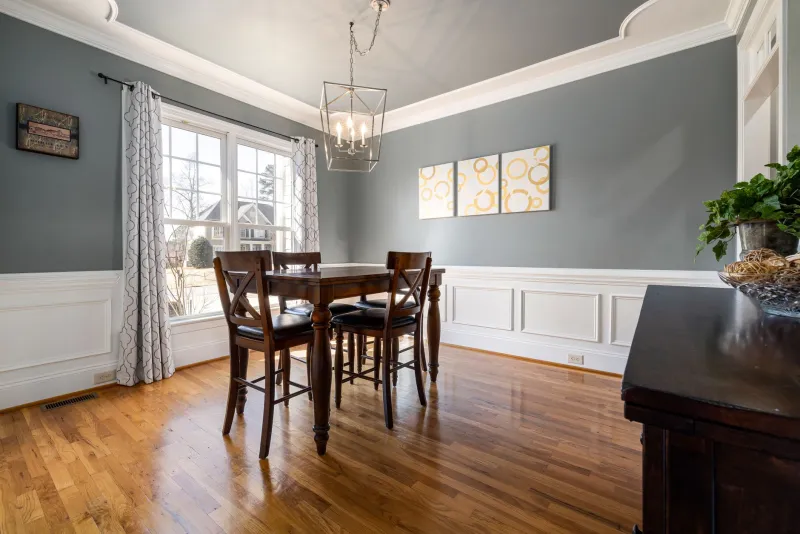
Instead, treat it as a single strong note. A dark walnut chest against pale walls and a plain rug; a scrubbed pine table with modern chairs and a low pendant; an oak sideboard under a large contemporary print. Resist the urge to complete a matching set, and keep the tone of the timber in mind — warm honeyed woods sit better with creams and olive greens, while darker woods take charcoal, deep blue and brass well.
And protect the floor. A set of felt pads under the legs costs almost nothing and saves an oak floor for another fifty years.
There's a quiet sustainability argument here, too. Every piece that gets restored rather than replaced keeps good timber out of landfill and avoids the carbon of a new build. But mostly, it's better furniture for less money, with a story attached. Hard to argue with that.