Oak, Ash and Grandma's Dresser: How to Mix Wood Tones Without the Clash
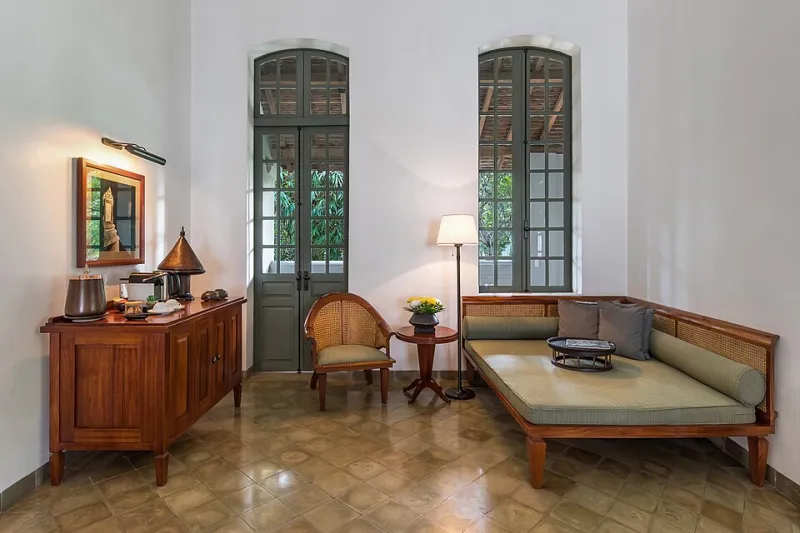
Photo: Basile Morin, CC BY-SA 4.0, via Wikimedia Commons
There is a particular kind of anxiety that sets in when you've just bought a pale ash sideboard and you're standing in a room that already contains a honey-oak floor, a dark walnut coffee table inherited from a parent, and a pine bookcase you've been meaning to paint for four years. It looks, you suspect, like a car boot sale.
It probably doesn't. But the worry is real, and the usual advice — "just make sure everything matches" — is both impossible and slightly sad. Matching sets date fast, they flatten a room, and they quietly dismiss the furniture you already own and love.
What follows isn't a trend piece. It's a system you can apply in any room, in any house, whether you're in a Victorian terrace in Sheffield or a new-build in Bristol with a glass box on the back.
Start with what's already there
Before you buy anything, walk the whole house with a notebook. List every wooden element: floors, doors, skirting, window frames, stair handrails, worktops, furniture, picture frames. Note the colour and, more importantly, the direction of the grain. You'll usually find you already have a dominant timber — often floorboards, often pine — and that's your anchor. Everything else is in conversation with it.
This matters because most "clashes" aren't about species at all. Oak hates nothing. What fights is temperature: a cool grey-brown next to a hot orange-brown, or a flat matt next to a high gloss.
Think in undertones, not species names
Forget oak versus ash for a moment. Ask whether a wood reads warm (red, orange, golden), cool (grey, ash-green, taupe) or neutral (creamy, sandy).
- Warm: pine, honey oak, cherry, teak, most reclaimed timber
- Cool: grey-weathered oak, limed ash, ebonised finishes, driftwood tones
- Neutral: pale ash, birch, maple, sycamore, light beech
A room works when you pick a temperature and stay near it, allowing one deliberate outlier. A warm room with one cool grey piece reads as characterful. A room with three warm pieces and three cool ones, scattered at random, reads as unresolved.
Walnut is the exception worth understanding. It's warm but very dark, so it behaves more like a contrasting object than a background tone. Treat a walnut piece the way you'd treat a navy armchair: a good punctuation mark, not a wall colour.
The rough 60/30/10 split
Borrow the old interiors rule and apply it to timber. Around 60% of visible wood should be your anchor tone — usually floors, doors, big built-ins. About 30% can be a secondary tone, slightly lighter or darker but in the same family. The last 10% is your wildcard: the blackened ash stool, the walnut chest, the painted pine dresser.
It's not a law. It is, however, a useful way to stop yourself buying a fourth mid-brown item that neither anchors nor accents anything.
Room by room
Living room. This is where inherited pieces tend to land, so lead with them rather than fighting them. If you have a dark Victorian mahogany chest, don't try to lighten the whole room around it — give it a wall of its own and keep the surrounding timber pale and quiet. Patterned textiles in a mix of tones do more to unify mismatched wood than any amount of sanding.
Kitchen. The busiest room and the one where too many tones genuinely do grate. Choose one timber for the working parts — worktops or door fronts, not both in competing species — and let the floor be different but restrained. Open shelving in a pale wood next to mid-oak cabinets looks intentional if the shelf thickness is similar; add a painted element (an island in a soft sage or off-white) and the whole thing relaxes.
Bedroom. Small rooms tolerate contrast better than people expect, as long as it's deliberate. A dark walnut bedside against a pale ash bed frame is a classic pairing, not a mistake. What looks messy is three mid-tones of similar depth but different hue — that half-tone problem again.
Hallway. Narrow halls make wood look darker than it is, because there's less light bouncing around. Lean lighter here and don't be precious about it: a painted pine console is doing more for your hallway than a display of four different hardwoods ever would.
Follow the light
North-facing rooms push timber towards grey and cool. Warm-toned wood can look muddy in them, so this is where ash, sycamore or a limed oak earns its keep — or where you bring in a warm-toned lamp rather than a warm-toned table.
South-facing rooms flood everything with gold, which flatters oak and pine but can make very pale ash look slightly washed out. East light is cool and blue in the morning; west light is amber and long. If you're choosing a big piece you'll live with for twenty years, look at samples in the actual room, at the actual time of day you use it, and leave them there for a week.
Period homes and modern extensions
In period properties, the building itself usually supplies the warm anchor — floorboards, pine doors, original beams. Resist adding more of the same; introduce pale or painted pieces so the old timber can be seen properly.
In a modern extension, where the light is generous and the palette is often cool greys and whites, warm timber does the softening work. A single wide-plank oak table in a glass-walled kitchen will carry the whole room. Adding a second and third timber in a similar tone tends to make the space look busier without making it feel warmer.
A short set of rules to keep in your pocket
Repeat one tone at least twice per room — a lone species looks accidental, a repeated one looks chosen. Keep sheen consistent where pieces sit beside each other; a satin finish next to a high-gloss laminate will always look wrong. Use paint and textiles as the neutral bridge between two timbers that argue. And leave room for the thing you inherit later, because you will.
One last thought from us. Wood is a natural material and it will never be entirely uniform, even within a single board. That variation is the point. Aim for a house that feels collected, not coordinated.