The Third Room: Turning a Spare Bedroom into a Solid Wood Study
Most home offices in this country are not offices at all. They are 2.4 metres by three, with a radiator where the desk wants to go, a door that swings the wrong way, and a window that faces either blazing south or a grey north wall. None of that is a disaster. A workspace needs surprisingly little — but it does need the right few things in the right places, and solid wood is unusually good at being those few things.
Begin with the chair, then work backwards
People shop for desks by looking at desks. It's the wrong order. Sit down first. Your elbows should rest at roughly the height of the worktop, your forearms level, your feet flat. For most adults that puts the desk surface somewhere between 72cm and 75cm from the floor — but if you're tall, short, or fond of a footrest, that number moves, and a fixed-height desk that ignores it will have you hunched by February.
Depth matters more than width in a small room. Sixty centimetres is the bare minimum for a monitor plus a notebook; seventy is comfortable; eighty is glorious and rarely possible. In a genuinely tight spare room, a 50cm-deep wall-hung oak top gives you a workable surface and hands the floor back to you, which makes the whole room read bigger than it is.
The wobble question
A desk takes more punishment than any other piece of furniture in the house. It gets leaned on, shoved, half-sat-upon and dragged. So look at the frame, not just the top. Legs set at the very corners with an apron or stretcher between them will stay true for decades; slim tapered legs on a wide span will develop a shimmy the moment you start typing with any enthusiasm.
Twenty-five to thirty millimetres of solid oak or ash is the right thickness for a working top — enough to resist a slow sag and heavy enough to feel planted. If your floorboards are the wonky Victorian sort (and they usually are), adjustable feet or a pair of timber levelling wedges are worth more than any aesthetic upgrade. Felt pads underneath, always. They protect the boards and they stop the whole room amplifying every mouse click.
Where the cables actually go
Nobody enjoys this part, so do it once. Two decisions cover ninety per cent of setups: a gap at the back of the desk, and somewhere to put the spaghetti that isn't the floor.
If you're buying off the shelf, look for a desk with a rear rail set slightly forward of the wall — five centimetres is enough for plugs and a cable to drop through. If you're going bespoke, ask for a channel routed into the underside with a grommet near one leg; it costs almost nothing at the workshop stage and it's near-impossible to retrofit neatly. A lidded cable tray screwed beneath the top hides the extension lead, the router and the shame.
Screens, shelves and the height of things
The top of your monitor should sit at about eye level, roughly an arm's length away. That's the ergonomics. The interiors version is this: a shelf directly above the desk is lovely, but only if there's at least 45cm of clear air beneath it, or you'll be ducking under it every time you stand up.
Higher shelves — 140cm and up — are for books and the things you want to look at rather than reach for daily. In a north-facing room, keep the wall behind the desk pale: ash, birch or limed oak, with a warm bulb behind the screen rather than overhead. In a sunny south-facing room, the reverse applies; a mid-tone walnut or smoked oak will absorb some of that glare and stop the whole room feeling like a greenhouse at four o'clock.
Storage that hides the mess
A home office has two personalities. On a Tuesday morning it's a desk, a monitor and a mug. At the weekend it's where the Sunday papers, the printer, the box files and the half-finished sewing project live. Both need somewhere to go.
Open shelving is for the photogenic third of your belongings. Everything else — the paperwork, the spare toners, the tangle of chargers — wants doors. A run of low cupboards at 40cm deep, or a shallow bookcase no deeper than 28cm, will swallow more than you expect without stealing floor space. Bookcases deeper than 30cm are wasted in a small room; the books fall forwards and the front half becomes a shelf for dust.
When the room is genuinely small
Go shallow, go up, and consider fitted. A bespoke desk and shelf unit cut into an alcove beside a chimney breast is the single best use of awkward period-house geometry you can buy — it fills the dead space, needs no legs in the middle of the floor, and can wrap a radiator if the pipework allows. Fitted doesn't have to mean forever, either: a well-made solid timber unit can be unscrewed and moved, unlike the particleboard version that disintegrates at the first removal.
One thing to avoid: deep wardrobes used as office storage. They eat half a metre of a three-metre room, and you only ever use the front 20cm.
Living with the furniture you already own
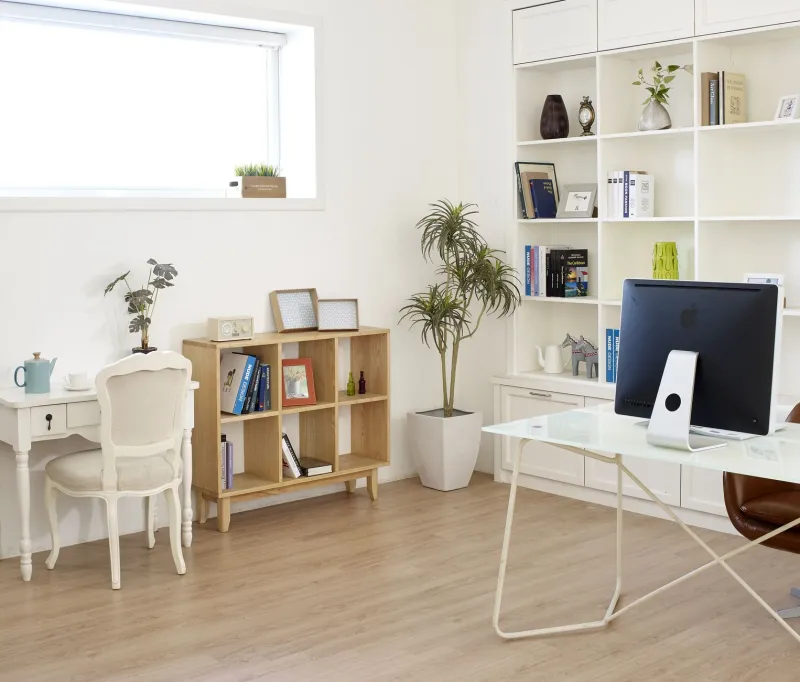
You almost certainly have a floor, and a floor is a wood tone. Don't try to match the new desk to it. Instead, treat the floor as the neutral and repeat your timber tone at least twice elsewhere — desk top and shelf, shelf and drawer fronts — so the room reads as deliberate. Warm honey oak next to cool pale ash is fine provided something painted sits between them. A white or sage-green cupboard, a linen shade, a jute rug: these are the commas that stop two woods arguing.
The annual five minutes
Solid wood in a heated British house will move. That's normal. Once a year, go round with a screwdriver and a cloth: tighten the frame fixings, wipe the top with a damp cloth and a drop of oil if it's looking thirsty, and check the felt pads haven't worn through. That's the whole maintenance regime. Do it and the desk will outlast the job, the laptop and probably the house.
Get the height, the depth and the cables right, add one decent cupboard, and the room stops being a spare bedroom with a chair in it. Which is the point. You should be able to close the laptop on a Friday and see a room, not a workstation.