The Echo Test: Where Solid Wood Really Helps a Noisy Room — and Where It Doesn't
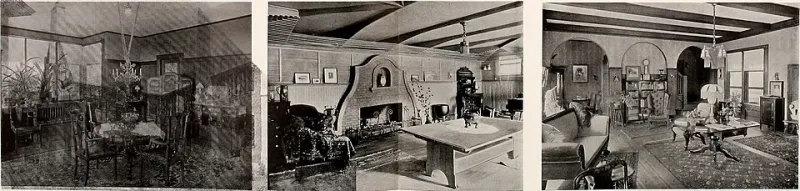
Photo: Internet Archive Book Images, No restrictions, via Wikimedia Commons
Walk into two living rooms of identical size, one furnished in veneered MDF and one stuffed with solid oak, and you'll notice the difference before you can name it. It isn't just the grain or the weight of the thing. The room sounds different. Voices sit differently. You stop raising your voice without realising you'd started.
That's not mysticism, and it isn't marketing. It's just physics, plus a bit of common sense about how UK homes are actually built. But it's also a subject where a lot of nonsense gets sold, so let's be clear about what timber does, what it doesn't, and where your money is best spent.
How a room gets noisy in the first place
Sound is energy looking for somewhere to go. When it hits a hard, flat surface — plaster, glass, tiles, bare floorboards, a lacquered tabletop — most of it bounces straight back at you. Do that between two parallel walls and you get flutter echo, that hollow clattery quality familiar to anyone who has sat in an unfurnished new-build or a stripped Victorian terrace mid-renovation.
The fix is rarely one thing. You need to break up the reflections, add something soft to soak up the higher frequencies, and occasionally add mass to stop sound travelling through a wall. Furniture plays a part in the first two. Almost none in the third.
Why wood behaves the way it does
Solid timber is dense and fairly rigid, which means it reflects sound rather than absorbing it. An oak tabletop is closer to a plaster wall than to a sofa cushion. So a room full of wood isn't a room full of softness.
What timber does well is three quieter jobs. It adds mass, which takes a little energy out of sound passing through it. It diffuses, scattering reflections in different directions when its surface isn't one flat plane — think open shelving, slatted panels, the varying depths of a dresser. And it holds the things that actually absorb sound: books, textiles, the felt behind a panel, the rug underneath the chairs.
Get those three working together and the room calms down noticeably.
The bookshelf is the book, not the shelf
This is the most misunderstood piece of furniture in the house. An empty oak bookcase is, acoustically speaking, a decorative diffuser and not much more. Fill it with books, magazines, boxes and the usual clutter of a lived-in home and it becomes one of the most effective absorbers you can put against a wall — soft paper, irregular spines, air gaps.
The same logic applies to a dresser with plates on it, or a sideboard with a lamp, a plant and a stack of records. The timber is the frame. The contents do the work.
If you're buying a bookcase partly to soften a room, buy one with genuinely deep shelves and vary what goes on them. A uniform row of identical hardbacks looks tidy and reflects more than you'd think.
Tables, chairs and the dining-room clatter
Hard-floor kitchen-diners are the classic UK echo box: glass doors, tiled floor, a big flat ceiling and nothing to interrupt any of it. A solid oak table alone won't fix that. In fact, a bare table with bare chairs on a bare floor can make it worse, because it adds another reflective surface at exactly the height where voices travel.
Add a rug underneath and upholstered seats, though, and the table starts earning its keep. It anchors the room, breaks up the floor plane, and the chairs around it absorb and scatter. Same table, completely different acoustic result.
Wardrobes, mass and the party wall
A run of fitted solid timber wardrobes along a shared wall does a modest amount of good: mass is mass, and a heavy carcass with a full set of doors will take the edge off everyday noise coming through. It is not soundproofing. It will not stop a bass line, a dog, or a neighbour's early-morning spin class.
Where fitted storage really helps is the room it's in. A wall of flat doors gives you a large, solid, uninterrupted surface — useful if it faces a window, less useful if it mirrors another blank wall. If you have a choice, put the wardrobe on the wall that most needs breaking up, not the one that's easiest.
Panelling: separate the real from the decorative
Slatted timber wall panelling is everywhere at the moment, and it does look handsome. Acoustically, plain slats on battens act as a diffuser — they scatter reflections rather than absorbing them. That's a genuine improvement in a hallway or stairwell where you get a lot of slap-back, but it's a modest one.
Acoustic slat panels with a felt or recycled-wool backing are a different animal. Those absorb mid and high frequencies properly and are one of the few decorative products that will measurably quieten a room. Worth knowing before you pay a premium for something that turns out to be ornamental.
Traditional tongue-and-groove on battens sits somewhere in between: a little diffusion, a little absorption behind the boards, a lot of character. Honest, if not transformative.
Practical placement, room by room
A few rules that hold up in most UK homes:
- Break the parallel walls. If one wall is blank, don't leave the one opposite blank too. A bookcase, a screen, a wardrobe — anything with depth.
- Put the biggest piece opposite the sofa or the telly, where reflections would otherwise fire straight back at you.
- Choose a corner for tall storage. Corners are where echo builds up.
- Rugs and curtains still do more per pound than any piece of furniture. Wood is the supporting act, not the headline.
- In a Victorian terrace with high ceilings, the problem is often volume rather than echo. Tall furniture helps a bit; soft furnishings at head height help more.
If you rent
You can do plenty without a drill. A freestanding oak bookcase loaded with books, a wardrobe, an upholstered headboard, a folding screen, a thick rug. Keep vents and radiators clear, avoid blocking trickle vents in window frames, and don't lean anything heavy against a stud wall in a way that lets it rattle.
Where wood simply won't help
Traffic noise, aircraft, airborne sound from next door, footsteps overhead, low-frequency bass. Those are problems of mass, sealing and decoupling, and no amount of furniture will solve them. A joiner is not an acoustic engineer, and anyone who tells you a dresser will fix a neighbour problem is selling you a dresser.
It's also possible to overdo it. A small living room packed with heavy timber and thick rugs can end up feeling dead and airless — too much absorption is its own kind of unpleasant. Aim for balance, not silence.
The honest summary
Solid wood won't soundproof your house. What it will do, in the right place and with the right things sitting on it, is take the hard edge off a room — the clatter, the bounce, the slight irritation you can't quite name when you're trying to have a conversation. And that, for most of us, is the actual problem worth solving.
Choose timber you can live with for decades, fill it with the stuff of ordinary life, and put a rug down. Your ears will notice before your eyes do.