The Halfway House: Solid Wood Furniture for a Garden Room That Lives Outside the Central Heating
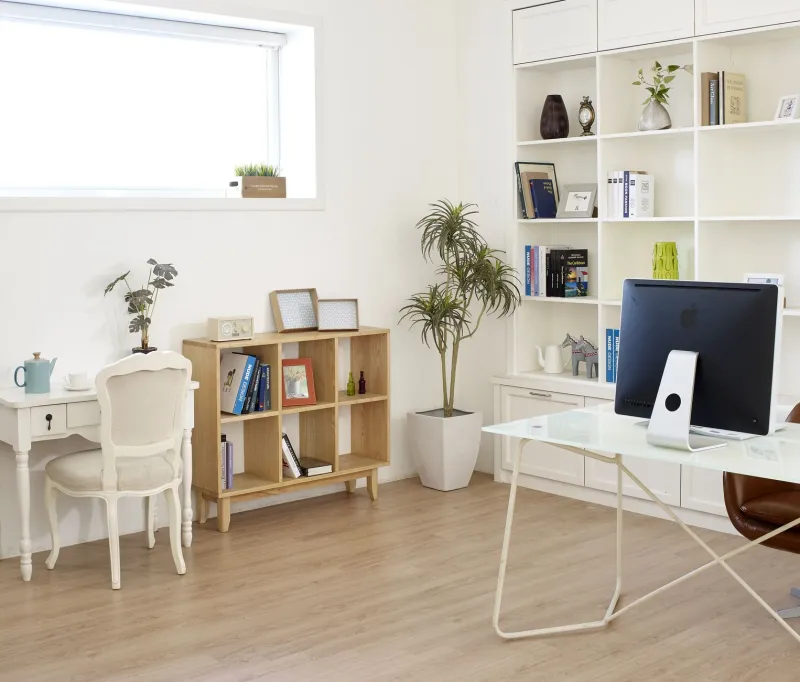
Photo: Syced, CC0, via Wikimedia Commons
A garden office is a gorgeous idea in June. By the middle of February, with the frost on the roof felt and the kettle steaming away on the desk, it becomes a rather different proposition. Not a bad one — plenty of us now work out there happily all year — but a room that asks a bit more of its furniture than the spare bedroom ever did.
The awkward truth is that a garden room isn't really indoors. It's a halfway house: better insulated than a shed, far less stable than a house, and subject to temperature and humidity swings that happen over hours rather than months. Solid wood can handle that beautifully, but only if you pick it and fix it with the room's habits in mind.
Start with the climate, not the colour scheme
Before you fall for a particular desk, spend a tenner on a hygrometer and leave it out there for a fortnight. You're looking for two numbers: how cold it drops overnight, and how humid it gets after a wet weekend with the door shut.
Most UK garden rooms drift between roughly 40% and 75% relative humidity across the year, and the fast swings are the ones that matter. A centrally heated house changes slowly; a timber cabin with a fan heater and a laptop in it can go from 6°C to 20°C between eight in the morning and lunchtime. Wood responds to that by taking on and giving off moisture, which means movement — a few millimetres across a 600mm-wide desk top is normal and nothing to panic about.
What you want to avoid is furniture that fights the movement, or timber that's too thin and too dry to cope with it.
Timber that takes a mood swing
Oak is the obvious starting point and deservedly so: dense, repairable, and happy to be re-oiled every couple of years. Ash behaves similarly and is a touch springier and paler, which suits a small room that needs all the light it can get. Sweet chestnut and Douglas fir are worth a look for shelving and carcasses — both are stable, both grow here, and both look better with a bit of honest wear on them.
What I'd steer clear of in an outbuilding is the very thing that thrives in a dry flat: thin veneered board with sealed edges. In a damp-cold-damp cycle the veneer and the core move at different rates, and the result is lifting, blistering and a piece you can't repair. Solid timber, by contrast, can be sanded back and refinished more or less indefinitely, which is the whole argument for buying fewer, better pieces in the first place.
One practical note: let anything new acclimatise out there for a week before you build it in or seal it. It will move as it settles, and better that happens on the floor than inside a fixed frame.
Finishes: breathable beats bulletproof
A hardwax oil or an oil-wax blend is the right call for most garden-room furniture. It soaks in rather than sitting on top, lets the timber breathe, and — crucially — can be spot-repaired with a cloth and twenty minutes. A desk top wants two or three coats, with the underside done just as thoroughly as the top. Ignore the underside at your peril; that's where moisture gets in.
Lacquers and polyurethane seal the surface completely. On a desk they're tough and wipeable, which is tempting, but they crack and craze when the wood beneath them moves, and then the water gets in through the cracks with nowhere to escape. If you do want a film finish, make sure every face is sealed, including the back edges and the underside, and accept that it will need stripping at some point.
Soap finish suits ash and pine nicely and is easy to top up, but it's not a desk surface for someone who eats lunch at the keyboard.
Fixing things without fighting the wood
This is where most garden-office fit-outs go wrong. A desk squeezed into an alcove and screwed to both walls has nowhere to go when it swells; the screws win, the timber splits, and you get a hairline crack along the grain that will slowly open up.
The fix is simple and old-fashioned. Fix to one plane only, and give the rest room. Leave a 5mm gap at each end of a shelf that runs between two walls, or use slotted brackets and oval screw holes so the piece can slide as it moves. When fixing battens to a wall, drill oversized pilot holes and use washers so the screw holds the batten without clamping the timber rigid.
For desks, adjustable feet are your friend: they keep the top off a cold floor, let you level the thing on an uneven slab, and mean the piece isn't pinned at four points. Wall-hung desks should go into studs or masonry, never into plasterboard alone, and a solid oak top of 25mm at 1400mm wide will weigh the best part of 35kg before you've put a monitor on it.
Condensation is the quiet enemy
Damp in a garden room rarely arrives through the roof. It arrives on your breath, in a kettle, off wet coats and dogs, and it condenses on the coldest surface available — which in winter is often the window glass and the wall behind your desk.
A few habits make a big difference. Keep furniture at least 50mm off external walls so air can move behind it. Stand storage on treated battens rather than flat on the floor. Fit trickle vents or open a window for ten minutes after lunch, even in January, because a proper air change beats a sealed warm fug every time. And avoid paraffin or unflued gas heaters entirely: they put water into the air as they burn, which is the last thing a timber room needs.
Background heat on a thermostat, even at 10°C, is kinder to wood than a blast of heat twice a day.
The last ten per cent
A wool rug, a linen cushion or two and a pair of curtains do more than soften the look. They buffer the worst of the humidity swings, quieten the acoustics of a hard-sided room, and make the space feel like somewhere you'd choose to sit rather than a shed with a chair in it.
Get the timber right, give it room to move, and keep the air moving too. Do that, and a solid wood desk will still be earning its keep out there when the shed next door has quietly rotted through its second set of shelves.