The Warm Floor Test: Choosing Solid Wood When the Heat Comes From Below
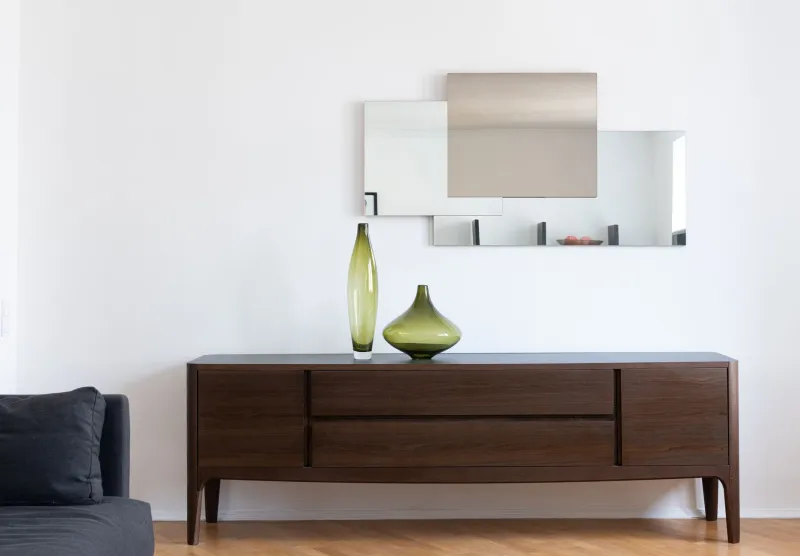
Underfloor heating used to be a luxury you found in grand bathrooms and the occasional new-build. These days it turns up in kitchen extensions in Sheffield, converted barns in Devon and mid-terrace renovations from Cardiff to Dundee. It's quiet, it's invisible, and it's lovely underfoot on a February morning.
It also changes the microclimate of a room in ways that furniture notices long before you do. If you're buying solid wood for a heated floor, a little forward planning goes a long way.
Why a warm floor is a different environment
With radiators, heat arrives in bursts and mostly stays up in the air where you feel it. Underfloor heating works differently: a large, gentle heat source spreads across the whole floor slab or buildup, and the surface temperature sits somewhere around 25–29°C in most domestic systems. That warmth radiates upward, and it's remarkably even.
For furniture, the relevant detail is what happens at the point of contact. A solid oak cabinet with a flat plinth sitting straight on a heated screed is effectively being warmed from the bottom up, continuously, for months at a time. Timber is a hygroscopic material — it moves with its environment — and uneven, sustained heat at one face is exactly the sort of thing that encourages a panel to cup, a joint to loosen or a finish to dry out.
None of this is a reason to avoid wood. It's a reason to choose it thoughtfully.
Start with the legs
This is the single most useful thing you can look at. Raised furniture — on tapered legs, turned legs, hairpin frames or a simple recessed plinth — lets air circulate underneath. That air gap moderates the temperature at the base of the piece and gives moisture somewhere to go.
Aim for at least 20–30mm of clear space under the lowest structural point. Chunkier legs are fine; it's the gap that matters, not the diameter. What you want to avoid is a fully closed base sitting flush on the floor for the whole footprint of a large piece — a heavy sideboard or a wardrobe skirted right down to the boards.
If you've fallen for something with a solid plinth, ask whether the maker can add discreet feet or a vented recess. Most workshops will happily oblige, and it's a far cheaper conversation to have before delivery than after.
Watch the footprint, not just the height
A small stool on a warm floor is a non-event. A two-metre oak bookcase pressing down on the same square metre for a decade is a different proposition. Broad, continuous contact plus weight plus constant low-level heat is the combination to think about.
Where a piece is genuinely large and grounded, consider:
- Felt or cork pads under feet, which slightly buffer the contact point and protect both surfaces.
- Spreading the load with a wider foot rather than a narrow point.
- Leaving a small breathing gap between the back of the piece and the wall, so air can move around it.
Timber choice matters, but less than you'd think
Oak, ash, elm and walnut are all perfectly workable over underfloor heating, provided the piece is well made. What matters more than species is how the timber was dried and how the panel was constructed.
Kiln-dried stock to around 8–10% moisture content is a sensible benchmark for UK interiors. Engineered boards — a solid timber face on a stable core — are often more dimensionally settled than wide solid boards, and they're worth considering for large table tops and long cabinet sides. Ask a maker directly what moisture content they work to and how they allow for movement. A good answer will be specific and unbothered. A vague one is worth noting.
Avoid the temptation to spec something exotic and thin. Stability comes from generous sections and sensible joinery, not from rarity.
Finishes that don't dry out
Heat pulls moisture from the surface of timber, and finishes feel that. Hard, brittle lacquers can craze over time in a warm, dry room. Oiled and waxed finishes are more forgiving — they flex a little with the wood, and you can top them up yourself with a cloth on a Sunday afternoon.
If you're going oiled, plan to refresh high-traffic surfaces once a year rather than once a decade. It takes twenty minutes and it's the cheapest insurance in furniture ownership. Avoid sealing the underside of a piece with a heavy impermeable coating while leaving the top breathable, or vice versa — mismatched faces are how panels cup.
Keep an eye on the room, not just the floor
Underfloor heating tends to run alongside well-insulated, fairly airtight rooms — the sort where humidity can drop in winter without anyone noticing. A cheap hygrometer on a shelf will tell you more than any amount of guesswork. Somewhere in the 40–60% relative humidity band keeps both people and timber comfortable.
If your room reads below 35% in January, a humidifier in the corner isn't fussy — it's sensible. And resist the urge to park a solid wood piece directly over the manifold or the hottest zone of the loop if you can help it.
Five questions for the maker
- What moisture content is the timber dried to, and how do you allow for movement in wide panels?
- Can you fit raised feet or a vented plinth for a heated floor?
- Which finish do you recommend, and how should I maintain it?
- Is the underside finished the same way as the top?
- What's your view on engineered versus solid boards for a piece this size?
Any workshop that answers these without flinching is one you can trust with a warm floor.
The short version
Underfloor heating and solid wood are a perfectly good pairing. Give your furniture some air underneath, keep an eye on room humidity, choose a finish you can maintain yourself, and buy from someone who talks about moisture content like it's a normal part of the conversation. Do that, and the warm floor becomes one of the nicer things about the room — for the oak as well as for your feet.